The rise and rise of House of Pickle — and what the court boom means for everyone else
Three years ago, finding an indoor pickleball court in Australia meant knowing someone. A tennis club with spare hours. A basketball stadium that would tape…
By PIKL Contributor · · 7 min read
Three years ago, finding an indoor pickleball court in Australia meant knowing someone. A tennis club with spare hours. A basketball stadium that would tape lines down on a Tuesday. A church hall, if you were lucky and the committee was friendly.
That era is ending, and the clearest evidence of it is a company that did not exist two years ago.
The rise and rise of House of Pickle
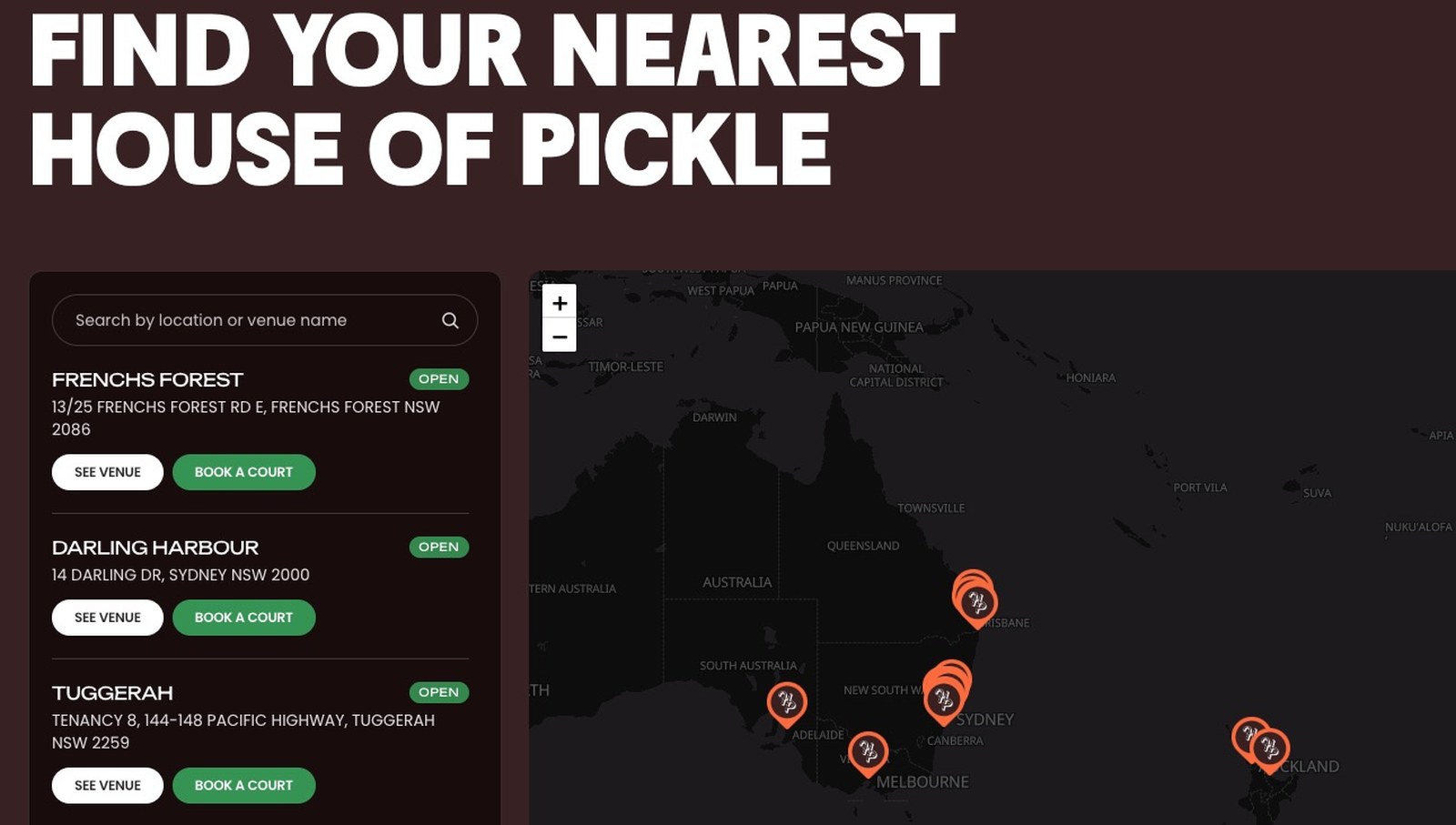
House of Pickle now lists eleven trading venues across four Australian states and New Zealand, with five more marked coming soon. Its own figure is 88 tournament-grade courts across 17 premium venues. Its stated ambition is to build the largest network of pickleball and padel clubs in the Asia-Pacific.
For a business founded in a sport most Australians had not heard of in 2023, that is a genuinely remarkable build.
Three people started it. Chief executive Ollie Matthews came from finance and property development, having previously founded and sold Open Air Events, which ran large-scale activations across Sydney. Chief operating officer Bryce Martiskin co-founded and sold that same events business with him. Chief development officer Aaron Lange built and scaled e-commerce brands across supply chain, influencer marketing and direct-to-consumer sales.
Events people and a direct-to-consumer marketer, in other words — which explains a lot about the pace, and about venues that feel more like hospitality than sport.
The team since assembled brings the sport itself. Chief financial officer Letha Gaigher holds an MBA, spent a decade across real estate and flexible workspace, captained an NCAA Division I tennis team and now competes professionally in pickleball. Coaching director Tek Tea is a Pickleball Australia-certified coach with multiple PPA event wins who has represented Australia at Masters level, heading a roster of around sixteen coaches, several of them national and state medallists.
The venues run on a model Australian pickleball has not really seen before: indoor, purpose-fitted clubs with court hire and paddles on arrival, drop-in social play where you need neither a partner nor a team, private and group coaching, clinics, learn-to-play sessions, DUPR assessments, leagues, tournaments and corporate days. Several carry a café, bar and pro shop. Memberships run in four tiers from around A$20 a week to A$50, billed monthly, cancel anytime.
Padel sits alongside pickleball at several sites. The Darling Harbour venue, delivered as an activation with Business Sydney and ICC Sydney, puts courts in the middle of the country's busiest convention precinct.
The expansion is funded through partners rather than from the balance sheet alone. House of Pickle invites outside capital at tiers from A$100,000 upwards, with partners either owning part of a facility or operating one, and landlords and developers with suitable sites invited separately. It is a model built for speed, and the results speak for themselves.
And they are not the only ones building
In August, Picklr — the largest indoor pickleball network in the world, with more than 500 clubs open or in development globally — opened its first Australian venue at Caringbah in Sydney's Sutherland Shire. Eleven permanent indoor courts. The company has said it plans up to 50 clubs across Australia and New Zealand, with Brookvale next.
Tennis Australia has expanded its partnership with the National Pickleball League to develop racquet sports venues and grow participation, bringing the country's largest racquet sport infrastructure into the picture. Shopping centres have started treating racquet sports as an anchor category rather than a curiosity, with a racquet club opening at Robina Town Centre specifically to meet padel and pickleball demand. Gym operators are opening venues. Tennis clubs are converting courts and adding lines at a pace nobody was predicting two years ago.
Add it together and Australia is about to have more dedicated pickleball courts than it has ever had, by a wide margin, in a very short space of time.
What that actually means for players
Start with the obvious: more courts means more chances to play.
Anyone who has spent a year in this sport knows the specific frustrations the shortage created. Sessions capped at whatever the hall could hold. Waitlists. Booking opening at 9am on a Monday and filling in four minutes. Driving forty minutes because the club ten minutes away had nothing available. Summer storms and winter southerlies wiping out the only outdoor option in town.
A build-out of this size dissolves most of that. Not immediately, and not everywhere — but in the catchments where it lands, the daily experience of playing changes.
More hours, and better ones. Dedicated venues run from early morning to late evening because that is their entire business. Players who work can finally get a weeknight session that is not the one slot a shared hall could spare.
Weather stops deciding. Indoor courts mean a session in February humidity, a session in a July southerly, a session during a storm. For a sport whose growth has been built outdoors, that alone extends the playing year.
Graded play becomes possible. You need volume to grade properly. A club with three courts runs one session for everyone; a venue with eight can run beginners, intermediates and advanced at the same time. That is the single biggest accelerator of standard there is, and it is only available at scale.
Real pathways appear. Coaching, clinics, DUPR assessments, leagues, tournaments — the ladder from first session to competitive play exists when a venue has the courts and the staff to build it.
Beginners stop being a problem to manage. In a court-starved club, a come-and-try session competes with regular play for space. In a venue with capacity, bringing new people in costs nothing. That matters more than anything else on this list for where the sport goes next.
The part operators should be thinking about
Here is what changes for the people running venues, and it is not primarily about who opens where.
For the last few years, Australian pickleball has operated in a seller's market. When courts are scarce, players take whatever they can get. Proximity and availability decide almost everything, and a venue can be mediocre and still be full.
That ends the moment a catchment has options. And once players have a genuine choice, they stop choosing on availability and start choosing on everything else — which is a far harder test.
What will they choose on? Not court surfaces. Every serious venue has decent courts. They will choose on the things that are much harder to build:
Whether the sessions are run well. Rotation that works, standards grouped sensibly, someone paying attention to whether the games are even. A badly run session with excellent courts is a bad session.
Whether a new player gets looked after. The first visit decides whether someone becomes a regular or never returns. Venues that have an actual answer for the nervous beginner on their own will take players off venues that leave them standing at the edge of a court.
Whether there is a community or just a booking system. This is the one that separates venues over a three-year horizon. People stay where they know names, where there is a ladder they care about, where someone noticed they missed a week. No amount of capital builds that, and no competitor can copy it.
Whether the coaching is real. Players who improve stay. Players who plateau drift away. A venue that gets people from 2.5 to 3.5 has customers for a decade.
None of that is a reason for existing clubs to be nervous. Community-run clubs and tennis venues have an enormous head start on precisely the things that turn out to matter most, and they should play to it rather than trying to out-spend anyone. The small club with twenty years of relationships and a committee who knows everyone's name is not competing with a corporate venue on fit-out. It is competing on belonging, and it is already winning that.
Good for the sport
It is worth stating plainly: this is a good moment for Australian pickleball.
Capital is flowing into courts. Operators are competing for players, which means they have to be better at looking after them. The sport is becoming visible in places — convention precincts, shopping centres, main-street retail — where people who have never held a paddle will walk past it. Every one of those is a player who would not otherwise have found the game.
Some venues will not make it. Some catchments will end up with more courts than they can fill. That is what a growth phase looks like in any category, and it is not a reason to want less of it.
The operators still standing in five years will be the ones who used this period to get genuinely good at running a venue — not the ones who simply opened the most. And players will have spent those five years with more courts, more sessions, better coaching and a better experience than they have ever had.
That is a fair trade.
Image: houseofpickle.com.au
- House of Pickle
- Picklr
- venues
- padel
- expansion
- clubs
- business